Remote-Controlled Slope Mower Buying Guide: How to Choose the Right Tracked Mower for Steep Terrain, Orchards and Rough Grass
A practical buying guide for contractors, farms and landowners choosing a remote-controlled tracked mower for steep slopes, orchards, rough grass and difficult terrain.
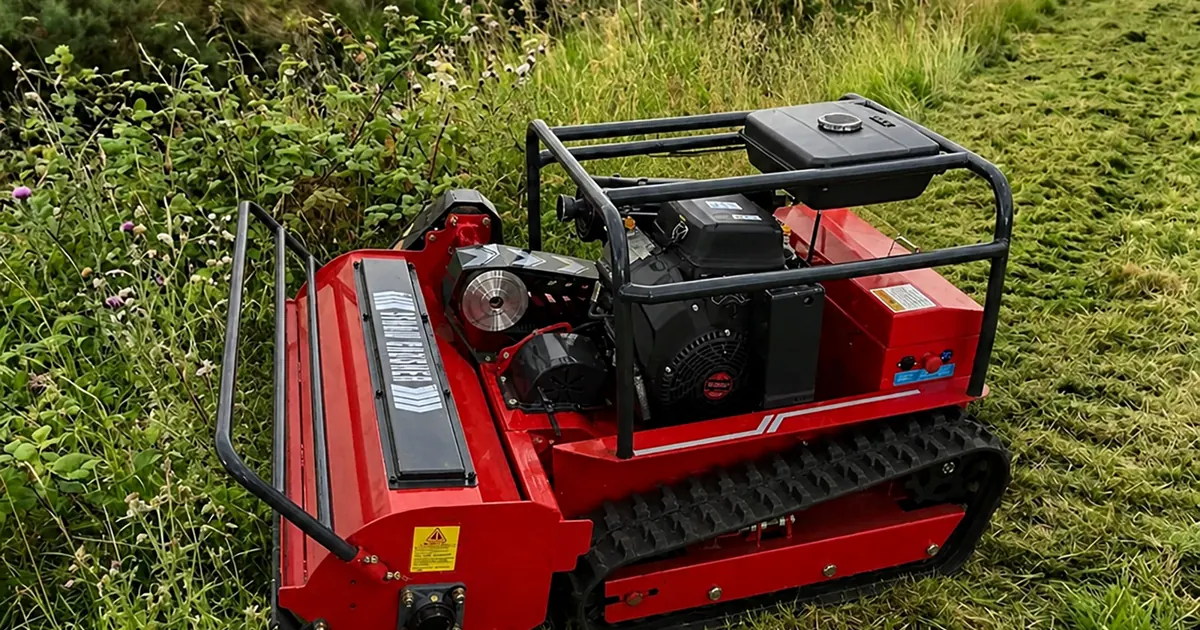
Start with the terrain, not the brochure horsepower
For buyers comparing slope mowers for vineyards and orchards on steep ground, the first filter is safe machine fit: row width, turning space, surface grip, vegetation load and transport access must be measured before horsepower or deck width. Review the orchard and vineyard application guide alongside this buying guide.
Most mower buying mistakes begin with the wrong question. Buyers ask for the largest engine or widest deck before they define the physical job. On a slope, the limiting factor is not only cutting power. The limiting factors are traction, stability, rollover risk, operator exposure, ground pressure, vegetation density and whether the machine can safely enter, turn and exit the site.
A remote-controlled tracked mower changes the job because the operator is no longer sitting on the machine or walking directly behind it. The machine carries the risk envelope; the operator manages the cut from a distance. That is why this category is most valuable for steep banks, orchard lanes, solar farms, roadside areas and rough grass that cannot be handled efficiently by a normal ride-on mower.
First-principles selection criteria
As slope angle increases, the mower needs more track contact, lower center of gravity and better remote visibility.
Fine grass, rough grass, tall weeds and light brush load the cutting system differently. A flail system is usually better for rough and mixed vegetation.
Orchards and vineyards often fail on access before they fail on power. Measure gates, rows, turning space and trailer loading method.
Tracked base versus wheeled base
Tracks spread the machine weight across a longer contact patch. That increases ground contact and reduces the chance of sudden wheel slip on uneven soil. For slope mowing, the advantage is contact geometry: a wheel touches the ground in a small patch while a track creates a longer patch.
| Decision factor | Tracked remote mower | Wheeled mower | Buyer implication |
|---|---|---|---|
| Steep slope grip | High, due to longer contact patch | Lower, especially on loose or wet soil | Tracks are preferred for unstable banks and uneven ground |
| Operator safety | Operator stays away from the machine | Operator often rides or walks near the machine | Remote tracked operation reduces direct exposure |
| Turning in tight lanes | Good when chassis size matches access width | Depends on wheelbase and steering radius | Measure orchard rows before selecting width |
| Transport | Needs ramp and trailer planning | Often easier for light-duty models | Commercial buyers should check loading height and trailer capacity |
How to judge slope risk before ordering
Do not rely only on a visual impression. A slope that looks manageable when dry can become dangerous after rain, under long grass or when the machine turns across the bank. The practical buying method is to classify the site into three levels.
- Low-risk slope: regular grass, firm soil, good visibility, easy access and enough turning space.
- Medium-risk slope: uneven soil, occasional ruts, mixed grass height, partial obstacles and limited access.
- High-risk slope: steep bank, loose soil, hidden stones, drainage ditches, wet sections or areas near roads, fences or panels.
For medium and high-risk sites, the remote-control advantage becomes important because the buyer is purchasing risk reduction as much as mowing capacity.
Cutting system: flail or rotary
A rotary deck works well for regular grass and open maintenance. A flail cutting system uses multiple small swinging tools that cut by repeated impact. For rough grass, weeds, mixed vegetation and contractor work, a flail system is usually more forgiving because individual tools can move when they meet uneven material.
| Vegetation | Better fit | Reason |
|---|---|---|
| Fine lawn grass | Rotary | Cleaner finish on regular turf |
| Rough grass | Flail | Handles mixed density and uneven growth |
| Weeds and light brush | Flail | Impact tools are more suitable for irregular vegetation |
| Unknown contractor sites | Flail | More tolerant when every site is different |
Buyer checklist before payment
- Measure access width, gate width, row spacing and trailer loading method.
- Classify vegetation: fine grass, rough grass, weeds, light brush or mixed unknown ground.
- Confirm slope condition in dry and wet seasons.
- Check spare parts availability: blades, belts, filters and routine service items.
- Confirm warranty, remote technical support and urgent air-freight spare parts process.
- Ask for order review before dispatch so the configuration matches the site.
Slope mowers for vineyards and orchards on steep ground: what to measure
The right machine cannot be selected from slope angle or cutting width alone. A vineyard or orchard combines cross-slope travel, narrow rows, headland turns, low branches, soft ground and hidden obstacles. Record the whole route from the unloading point to the final working area, because a mower that fits the vegetation can still fail on access or safe turning space.
| Site evidence | What to record | Why it changes the buying decision |
|---|---|---|
| Steepest working section | Measured angle or rise-over-run, surface direction and whether travel is up/down or across the slope | Defines the real terrain-risk discussion instead of relying on a visual estimate |
| Narrowest access | Gate width, row spacing, branch clearance and drainage crossings | Prevents a machine or transport setup from being too wide for the route |
| Turning area | Headland length, drop-offs, posts, trees and fence corners | Shows whether the machine can reverse or turn without entering a hazard zone |
| Vegetation load | Typical height, stem thickness, density, wet-season growth and any light brush | Separates regular mowing from flail-led vegetation control |
| Ground condition | Firm, loose, wet, rutted, rocky or erosion-prone areas | Changes traction, cutting-height and work-planning requirements |
| Daily workload | Area, working hours, travel between plots and seasonal passes | Connects machine fit to throughput, service planning and total operating cost |
Practical rule: use a phone inclinometer only as a screening aid, not as the sole safety decision. Confirm operating limits, working method and stop conditions against the current model documentation and the actual site.
Turn the site survey into a quote-ready buying brief
Before comparing a remote-control slope mower for sale, send suppliers the same evidence so price, configuration and delivery discussions remain comparable.
- Country and delivery postcode, plus whether access is commercial, agricultural or residential.
- Photos or a short video showing the steepest section, access gate, row spacing and turning area.
- Measured access width and approximate working area per maintenance cycle.
- Vegetation type, typical height and the heaviest seasonal condition.
- Preferred fuel direction, transport method and any required spare-parts package.
- The decision you need next: technical fit, current price, exact total, availability or dealer discussion.
Use the slope maintenance application guide for terrain planning, the orchard and vineyard guide for access constraints, or send the buying brief to GREEN SHINE for a practical review.
Buyer FAQ
What is the best mower type for steep slopes?
For steep slopes, a remote-controlled tracked mower is usually safer than a ride-on or walk-behind mower because the operator can stay away from the machine while the tracked base improves grip and stability.
Is a flail mower better than a rotary mower for rough grass?
For rough grass, weeds and mixed contractor sites, a flail mower is usually the stronger choice because the cutting tools handle irregular vegetation more effectively than a finish-oriented rotary deck.
Should I choose the widest mower available?
Not always. The correct width depends on access, turning space, trailer transport and vegetation density.
Can I buy directly from the shop site?
Yes. The shop site is designed for pricing, order review and purchase flow. For complex sites, review the application guide first and then proceed to the product page.
Continue Exploring GreenShine Guides
Compare mower types, review application scenarios, return to the main GreenShine site, or check current price and order options in the GreenShine store.