Remote-Controlled Mowers for Solar Farm Vegetation Management: A Practical Guide for O&M Teams
A practical guide for solar farm operations and maintenance teams evaluating remote-controlled tracked mowers for vegetation management under and around PV arrays.
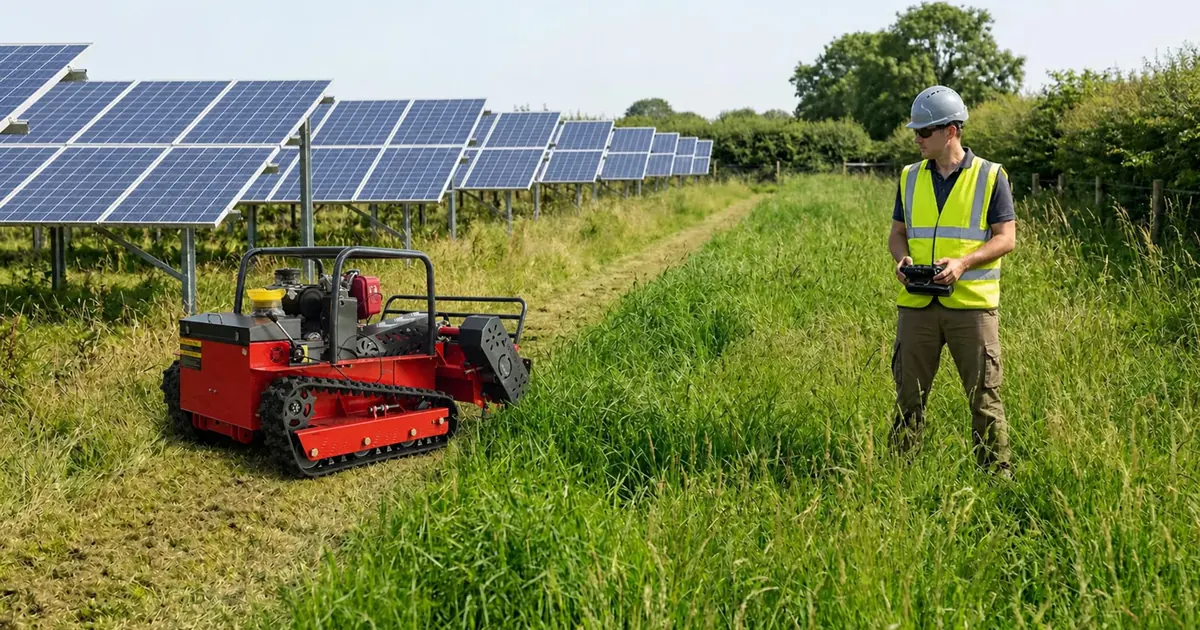
Solar vegetation is an operational risk
Vegetation inside a solar farm affects access, inspection, fire risk, shading management and routine maintenance. The job is repeated many times over the life of the site. That makes the correct equipment decision important: a slow manual method becomes expensive when repeated across many hectares.
Why remote operation fits solar farms
Solar farms often contain areas where a ride-on mower is uncomfortable or risky: sloped margins, drainage lines, tight turning spaces and uneven ground near panel structures. Remote operation allows the operator to stand where visibility is better and machine contact risk is lower.
Remote control gives the operator better viewing position near structural obstacles.
Tracked remote mowing can reduce repeated manual brush cutting.
The operator can stay away from unstable banks, tall weeds and hidden ground hazards.
Efficiency calculation
Solar O&M teams should calculate work by repeated cycles, not by one cut. The real cost is labor hours multiplied by annual passes, travel, downtime and areas that require manual finishing.
| Work zone | Best method | Reason |
|---|---|---|
| Open grass between rows | Remote tracked mower | Good balance of safety, access and repeatability |
| Low clearance directly under panels | Selective machine work plus manual trimming | Panel geometry and cable routes may limit access |
| Fence lines and corners | Manual finishing or small tool | Machines may not reach edges cleanly |
| Drainage banks and slopes | Remote tracked mower | Reduces operator exposure on difficult terrain |
Cable and panel protection
The operator must know the site layout. Cable routes, junction boxes, panel support posts and uneven mounting areas must be identified before work starts. Remote mowing is not a license to cut blindly. It is a method to improve control and reduce human exposure when the work path is planned.
- Map sensitive areas before mowing.
- Use slower travel near panel structures and cable routes.
- Keep cutting height appropriate for ground conditions.
- Separate machine mowing zones from manual trimming zones.
When contractor-grade equipment is justified
If vegetation work is frequent, distributed across multiple sites or performed by a dedicated maintenance contractor, a professional remote-controlled tracked mower can become a strategic asset. The machine reduces dependency on high-fatigue manual cutting and makes repeat work easier to schedule.
Automated vegetation management: automation vs remote control
Automated vegetation management and remote-controlled mowing are different operating methods. An autonomous system needs navigation, obstacle handling and a validated site boundary; a remote-controlled mower needs an operator to direct its movement and cutting. The GREEN SHINE mowers discussed here use remote control. A scheduled maintenance program does not make a machine autonomous.
Compare the two methods against the actual solar site: predictable open corridors may suit an automation assessment, while changing vegetation, drainage banks and cable-sensitive areas demand a work method matched to visibility, clearance and site risk. Confirm each system against its current documentation. Divide the site into machine routes, manual finishing areas and no-machine zones before comparing annual cost.
| Solar-site zone | Evidence to capture | Planning decision |
|---|---|---|
| Main row corridors | Clear width, turning length, panel overhang and ground slope | Defines the repeatable machine route and usable cutting envelope |
| Directly under panels | Minimum height, frame position, drip erosion and cable clearance | Separates machine-accessible strips from low-clearance manual finishing |
| Cable and electrical areas | Exposed or buried cable routes, combiner boxes, junctions and warning zones | Creates no-go or low-speed areas that protect electrical assets |
| Fence lines and corners | Corner radius, security hardware, access gates and accumulated debris | Estimates the remaining hand-tool workload |
| Drainage banks and uneven ground | Slope direction, soft soil, channels, ruts and seasonal water flow | Determines whether remote tracked access is suitable and where work must stop |
| Fire-management areas | Vegetation threshold, required cut timing and local site rules | Sets the frequency and priority of maintenance passes |
Calculate annual solar farm mowing demand
Compare methods over a full season. Start with maintained hectares, expected passes, machine-accessible percentage, manual finishing percentage, travel time and downtime allowance. A useful planning model is: annual workload = area × passes × time per hectare, plus manual finishing and site-transfer time.
Run the calculation for normal growth and the heaviest expected growth. This prevents a low one-day demonstration result from being mistaken for annual operating capacity.
What to send when requesting a solar farm mower quote
- Country, delivery postcode, site area and expected vegetation-control cycles per year.
- Minimum corridor width, lowest panel clearance and available turning length.
- Vegetation type, maximum seasonal height and any woody material.
- Slope, drainage, soft-ground and erosion areas marked on a simple site plan.
- Photos or video of panels, cables, fences, gates, ditches and typical working rows.
- The percentage of work expected to remain manual around sensitive assets.
- Required next step: technical fit review, current price, exact total, availability or contractor/dealer discussion.
Use the solar parks and utilities application page for route planning, or send the site brief to GREEN SHINE for a practical equipment discussion.
Buyer FAQ
Can remote-controlled mowers work under solar panels?
They can work in suitable rows and open areas, but very low clearance zones and cable-sensitive areas may still require manual trimming.
Why use a tracked mower in a solar farm?
Tracks improve stability on uneven ground, drainage banks and rough vegetation areas, while remote control keeps the operator away from hazards.
Is a flail mower suitable for solar farm vegetation?
A flail mower is useful where vegetation is rough, mixed or repeatedly overgrown. Fine trimming near cables may still require manual tools.
How should O&M teams justify the equipment cost?
Calculate annual labor hours, repeat passes, manual trimming load, downtime and safety exposure across the full maintenance season, not only one mowing event.
Continue Exploring GreenShine Guides
Compare mower types, review application scenarios, return to the main GreenShine site, or check current price and order options in the GreenShine store.