Why Remote-Controlled Tracked Mowers Are Safer for Steep Slope Mowing
A safety-focused guide explaining why remote-controlled tracked mowers reduce operator risk on steep banks, hillsides and difficult ground.
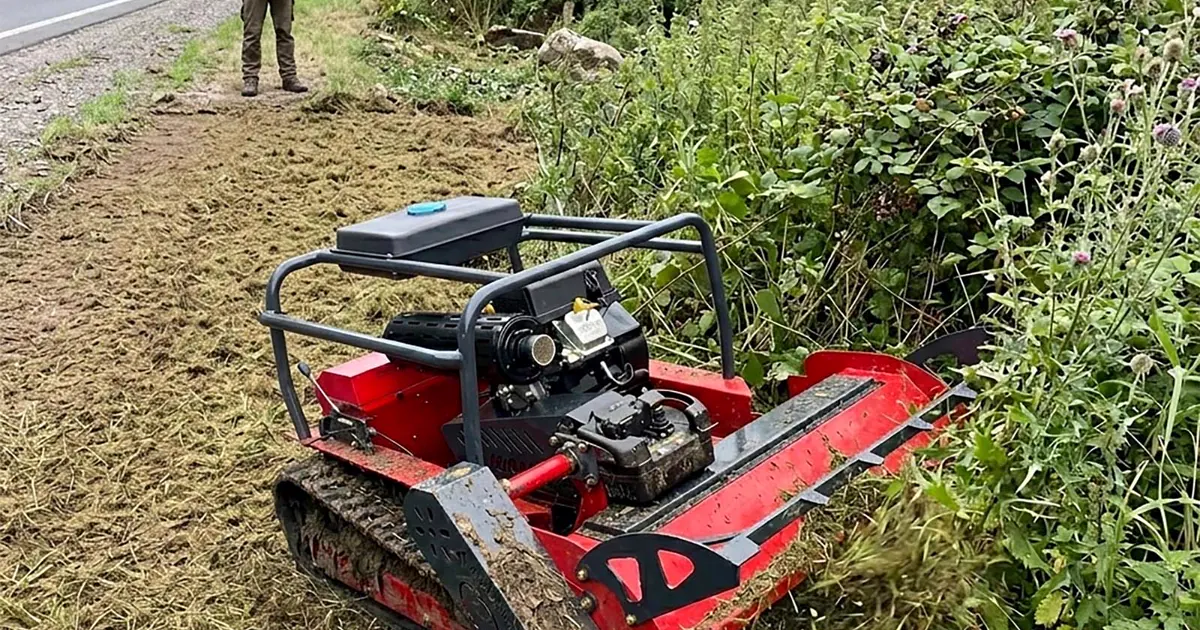
The real danger is the operator position
On steep ground, mowing risk begins when the operator must stand, walk or ride inside the same hazard zone as the machine. A slope adds gravity, side load, hidden holes, wet grass, loose soil and unpredictable turning forces. The machine may be powerful enough to cut, but the operator may be positioned where a slip, rollover or thrown object becomes unacceptable.
A remote-controlled tracked mower changes the safety equation. The operator can stand outside the most dangerous section and control travel speed, direction and cutting from a safer viewing point.
Why tracks matter on slopes
A tracked base distributes weight along a larger contact area. This improves grip because the load is not concentrated into four small wheel patches. On loose soil, ruts or rough grass, the track can maintain contact over uneven surfaces and reduce sudden loss of traction.
| Risk factor | Walk-behind mower | Ride-on mower | Remote tracked mower |
|---|---|---|---|
| Operator exposure | High: operator walks near deck | High: operator sits on machine | Lower: operator can stand away |
| Side-slope rollover risk | Body is near machine | Body is on machine | Body is off machine |
| Grip on loose ground | Limited by wheels and foot traction | Limited by tires | Improved by track contact patch |
| Fatigue | High on long banks | Medium but risky on severe slopes | Lower physical fatigue |
Center of gravity and turning discipline
Stability is not only about slope rating. The important question is how the machine behaves when turning, crossing ruts or contacting dense vegetation. A low and wide stance helps reduce tipping tendency, but safe operation still requires controlled speed and sensible travel paths.
- Work up and down a slope when conditions require maximum stability.
- Avoid sharp high-speed turns across steep side slopes.
- Slow down before entering unknown grass where holes or stones may be hidden.
- Keep the operator at a viewing point with escape space and clear line of sight.
What “45-degree slope” should mean to a buyer
A slope claim should not be treated as permission to mow every 45-degree surface at full speed. Real sites vary. Grass moisture, soil condition, cut height, obstacles and travel direction all matter. Buyers should use slope capability as a screening point and then evaluate the actual site.
When remote control is commercially justified
Useful for banks, estates, rough ground and recurring maintenance contracts where labor risk is high.
Useful for roadsides, drainage banks and public areas where operator safety is visible and important.
Useful when steep grass is repeatedly delayed because ordinary machines cannot work safely.
Slope mowing safety plan: pre-start checks and stop conditions
A remote mower for hills reduces direct operator exposure; it does not remove the need for a site plan. Walk the area before starting, divide it into work zones and define what will make the operator stop. The plan should be repeated when rain, vegetation height or public access changes the site.
| Hazard | Pre-start check | Stop condition |
|---|---|---|
| Loss of traction | Check wet soil, loose fill, ruts and the intended direction of travel | Track slip, uncontrolled drift or ground deformation appears |
| Rollover or slide path | Identify drop-offs, ditches, walls, roads and people below the work zone | The machine approaches an unprotected edge or cannot hold a controlled line |
| Hidden objects | Remove wire, stones, branches and debris that vegetation may conceal | Unexpected vibration, impact noise or cutting resistance occurs |
| Poor visibility | Choose an operator position with a clear view of the machine and its exit route | Vegetation, terrain or distance blocks direct observation |
| Public or traffic exposure | Control the work perimeter and identify roads, footpaths and property boundaries | A person, animal or vehicle enters the controlled area |
| Machine warning | Confirm emergency stop, controls and routine inspection items before work | Any control response, guard, track, blade or engine condition is abnormal |
Questions to settle before buying a steep-slope mower
- Can the operator maintain direct visibility from a stable position for the whole work path?
- Does the site require travel across the slope, up and down the slope, or both?
- What changes after rain, frost, long growth or seasonal erosion?
- Where can the machine stop, turn and exit without approaching a drop-off or public route?
- Which guards, emergency controls, inspection routines and personal protective equipment are required by the current manual?
- Who provides model-specific setup, parts and after-sales support after delivery?
Safety boundary: a published slope capability is not permission to operate on every bank with that measured angle. The current model documentation, site-specific risk assessment and local work rules govern the real job.
Continue with the slope maintenance planning page, review current manuals and support documents, or send site photos and measurements for a product review.
Buyer FAQ
Is a remote-controlled tracked mower safe on steep slopes?
It can significantly reduce operator exposure because the operator is not riding or walking directly beside the machine. Site conditions, speed and operating discipline still matter.
Why are tracks better than wheels on slopes?
Tracks create a longer ground contact patch than wheels, which improves traction and makes movement more predictable on loose or uneven ground.
Does a 45-degree slope rating mean every 45-degree bank is safe?
No. Soil, moisture, obstacles, grass density and travel direction affect safety. Slope rating should be treated as a capability indicator.
Who benefits most from remote slope mowing equipment?
Contractors, municipal crews, estate managers, roadside maintenance teams and landowners with repeated steep-bank mowing needs benefit most.
Continue Exploring GreenShine Guides
Compare mower types, review application scenarios, return to the main GreenShine site, or check current price and order options in the GreenShine store.